Open any sales playbook written in the last decade and you will find a follow-up framework built around the same logic. Send the proposal. Wait two days. Send a check-in. Wait five days. Send a value-add. Wait seven days. Send a final break-up email. Repeat across your entire pipeline.
This framework is taught everywhere. It is baked into every CRM sequence builder, every sales engagement platform, every SDR training program. And it is built on a fundamentally broken assumption.
The assumption is that time is what determines when to follow up.
It is not.
What Time-Based Follow-Up Actually Tells YouA time-based follow-up cadence answers one question and one question only. How long has it been since I last reached out.
It does not answer whether the buyer read your proposal. It does not answer whether they shared it internally. It does not answer whether they are actively evaluating it, quietly building a case against it, or whether it has already been forwarded to a decision maker you have never spoken to.
It answers none of those questions. It answers only the one question that matters least.
The person following up on day two because the calendar says day two is not following up at the right moment. They are following up because two days passed. Those are completely different things and they produce completely different results.
What Signal-Based Follow-Up Actually Looks LikeThe best salespeople you have ever met do not follow up on a schedule. They follow up on a signal.
They reach out when something happens. When a prospect replies to an old email thread at 11pm. When a referred contact asks an unexpected technical question. When a champion mentions in passing that someone new has been copied into the conversation. When a proposal that has been sitting untouched for a week suddenly gets revisited the morning before a budget meeting.
These people follow up at those moments not because a CRM reminder fired but because they noticed something and understood what it meant.
The gap between those salespeople and everyone else is not discipline. It is information.
The salesperson on a timed cadence and the salesperson following signals are working with completely different amounts of information about what is happening on the buyer side. One is guessing. The other is responding to evidence.
Why the Post-Proposal Stage Creates a Specific ProblemIn most parts of a sales cycle the salesperson has reasonable visibility. Discovery calls generate notes. Emails create a record. Meetings produce summaries. The CRM fills up with activity.
After a proposal goes out the visibility collapses almost completely.
The buyer takes the document into their organisation. Internal meetings happen. Stakeholders form opinions. Budget holders ask questions. Legal teams review terms. Procurement runs parallel assessments. The champion presents the case internally, wins arguments, loses arguments, navigates politics you will never see.
The salesperson knows none of this. Their last piece of information is that they sent the proposal. Everything after that is silence.
And into that silence they inject a time-based follow-up cadence. Day two. Day five. Day seven. Day fourteen. Each message carefully crafted. Each message sent into a void with no knowledge of whether it is landing at exactly the right moment or interrupting exactly the wrong one.
The Three Mistakes Time-Based Cadences CreateMistake one: following up too early into active internal evaluation.
Your champion is in the middle of building an internal case. Three new stakeholders from their organisation have read your proposal in the last 48 hours. The evaluation is alive and moving faster than you know. At this moment the right move is to give your champion space to do their job.
Instead your cadence fires a day-two check-in. Your champion now has to respond to you while simultaneously managing internal discussions. You have added work to their plate at the worst possible moment. You look like a vendor chasing an update rather than a partner supporting the process.
Mistake two: staying silent while a deal quietly dies.
Your prospect opened your proposal once, spent forty seconds with it, and has not returned. A week passed. Two weeks. Your cadence has not reached the day-fourteen break-up email yet so you are still classified as active in the pipeline. In reality the deal was over the moment they closed the document after forty seconds.
You spent two weeks of mental bandwidth and pipeline space on a deal that was already lost while the cadence was patiently counting down to the moment it would tell you to try one more time.
Mistake three: sending the wrong message at the right moment.
The moment to follow up has arrived. Your prospect came back and re-read the pricing section twice. Something specific triggered them to return. This is the ideal moment to reach out. But your cadence does not know any of this. It fires a generic check-in. Did you have a chance to review the proposal. Would love to connect if you have any questions.
The buyer who just spent twelve minutes re-reading your commercial terms gets a message that does not acknowledge anything they did. The opportunity to have a specific, contextual, well-timed conversation gets replaced with the same email your CRM sent to every other prospect at day five.
The Question Time Cannot Answer But Signal CanEvery follow-up decision ultimately comes down to one question. Is this deal alive right now and if so what is happening inside the buyer's organisation.
Time cannot answer this. The amount of time that has passed since you sent a proposal tells you nothing meaningful about the state of the deal. A deal can be three days old and already dead. A deal can be three weeks old and entering its most active phase of internal evaluation.
What tells you whether a deal is alive is buyer behaviour. Not buyer conversation. Buyer behaviour.
A buyer who opened your proposal yesterday, came back today, and spent eight minutes on the implementation section before forwarding it to a colleague is doing something. A buyer who opened your proposal three weeks ago, spent thirty seconds on the first page, and has not returned is doing nothing.
These two situations look identical in a time-based cadence. They look completely different when you have visibility into what the buyer actually did with your document.
What Salespeople Who Get This Right Actually DoKim Reina has spent years in Sales Operations supporting long, complex sales cycles. She described her most reliable signal for deal health in one sentence. A scheduled next step that the buyer put on the calendar themselves.
She is not looking at how long it has been. She is looking at what the buyer did. Buyer action is the signal. Seller activity is the noise.
Adrian Griggs has spent more than twenty years training enterprise sales reps. He described what a healthy deal sounds like versus what a slipping deal sounds like. A healthy deal sounds like people doing things. A slipping deal sounds like people talking about things.
Again the signal is action not time. A buyer who attended an implementation scoping call, introduced their procurement team, and asked for contract redlines is doing things. A buyer who keeps saying they will have an update for you next week but the update never comes is talking about things.
Neither of these signals has anything to do with how many days have passed since you sent the proposal.
Why This Is Harder Than It SoundsThe problem with signal-based follow-up is that signals are hard to see.
A buyer who introduces procurement is easy to observe. A buyer who is actively discussing your proposal internally is invisible. The most important thing happening in any complex deal after the proposal stage is exactly the thing the salesperson has zero direct visibility into.
The internal evaluation process happens entirely inside the buyer's organisation. The champion building the business case. The stakeholders forming opinions. The budget holder deciding whether to prioritise this or something else. The competitor being evaluated simultaneously. All of it is invisible to the salesperson.
This is why time-based cadences exist. Not because time is a meaningful signal but because time is the only signal most salespeople have.
When you have no visibility into what the buyer is doing the next best thing is to follow the clock. Day two. Day five. Day seven. At least it is structured. At least it does not require information you do not have.
The question is whether it is possible to have better information.
The Signals That Are Actually VisibleNot everything about what a buyer does after receiving a proposal is invisible. Some of it leaves observable traces.
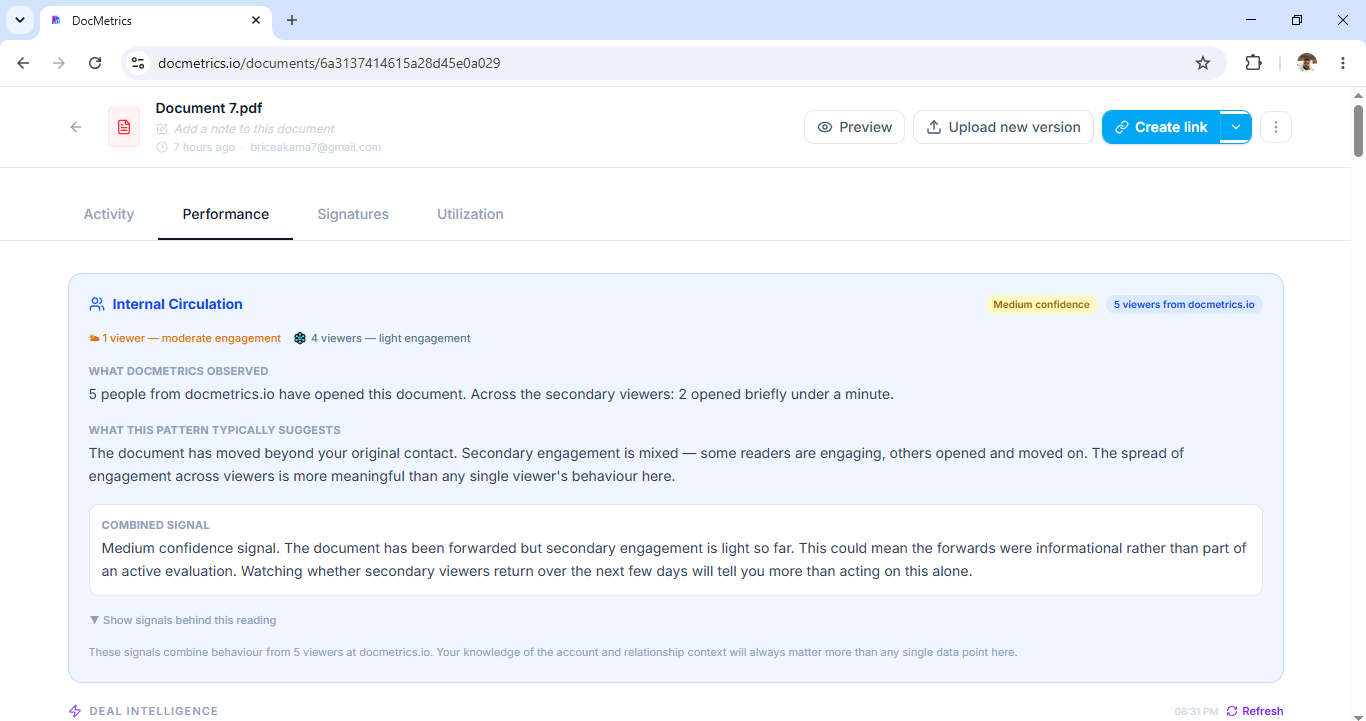
Whether the document was opened is traceable. Whether specific pages were read and for how long is traceable. Whether the document was forwarded to someone new at the same organisation is detectable when that person opens it with a different email address. Whether the buyer returned to re-read specific sections across multiple sessions is measurable. Whether the engagement is deepening over time or narrowing to a single contact is a pattern that emerges from the data.
None of these signals tell you everything. A buyer who spent eight minutes on the pricing page might be sold or might be horrified by the number. A proposal that reached three new stakeholders might be in active evaluation or might have been forwarded with a note saying this is not for us.
But they tell you something that time cannot tell you. Something happened. And something happening is the signal that the right moment to follow up may have arrived.
The salesperson who follows up after a proposal because five days have passed is guessing about the moment. The salesperson who follows up because three new people from the buyer's organisation opened the document in the last 48 hours is responding to evidence.
Both are following up. Only one of them knows why.
What Changes When You Follow Up On SignalThe first thing that changes is timing. You reach out when something is happening, not when the calendar says to.
The second thing that changes is the message itself. When you know that a buyer came back and spent time on the implementation section you do not send a generic check-in. You send a message that references implementation. When you know that new stakeholders appeared from the buyer's organisation you do not ask if they had a chance to review the proposal. You ask your champion who else is now involved and whether there is anything you can put together to help them make the internal case.
The specificity of a signal-based message is categorically different from the specificity of a time-based message. One sounds like you were paying attention. The other sounds like your CRM fired a reminder.
The third thing that changes is prioritisation. If you are managing ten active proposals simultaneously a time-based cadence treats all ten with equal urgency. Signal-based prioritisation tells you which two of those ten have something happening right now and which eight can wait another day.
Adrian Griggs asked a question that cuts to the heart of this. What percentage of the time does your follow-up approach change what you would actually do next compared to a rep who knew nothing and guessed. If the answer is not often then your follow-up approach is providing no information value. It is just structure on top of a guess.
The Practical ShiftChanging from a time-based to a signal-based follow-up approach does not require abandoning structure entirely. Time-based cadences as a fallback for when there is no signal are still useful. Something is better than nothing.
But the priority order matters.
When a signal appears, follow up on the signal regardless of where you are in the time-based cadence. The cadence is the default. The signal overrides the default.
When no signal appears, the cadence gives you a structure to avoid letting deals drift into complete silence. But follow it with awareness that you are guessing about the moment rather than responding to evidence.
The difference in outcome between these two approaches is not small. Every premature follow-up that interrupts an active internal evaluation costs you relationship capital. Every well-timed message that arrives when a buyer is actively thinking about your proposal earns it.
Over the course of a pipeline that sends dozens of proposals per month the cumulative difference is significant. Not in the size of individual deals but in the conversion rate from proposal to closed deal.
The Real Problem with Sales CadencesSales cadences were designed to solve a discipline problem. Reps were letting deals drift without following up at all. Structured cadences forced consistency. On balance they improved outcomes.
But they solved the wrong problem. The real problem was never that salespeople were not reaching out often enough. The real problem was that salespeople were reaching out without knowing whether they should.
A cadence tells you when to send a message. It does not tell you whether sending a message right now is the right move. It does not tell you whether the deal is alive. It does not tell you whether your champion is building momentum internally or losing the internal competition for organisational attention.
The next generation of follow-up is not a better cadence. It is better information that tells you when a cadence is not needed because something is already happening and when a cadence is exactly right because nothing has happened and it is time to create a moment.
That distinction is the difference between following up and following up well.
DocMetrics surfaces buyer-side signals after a proposal is sent — which sections were read, whether the document reached new stakeholders internally, and whether engagement is growing or narrowing. The goal is to give salespeople the information they need to follow up when it matters rather than when the clock says to. If you send proposals and want visibility into what happens after you hit send, try it at docmetrics.io.
DocMetrics Team
Writing about document sharing, analytics, and how teams use DocMetrics to track engagement and close deals faster.