There is a structural problem at the center of modern B2B sales that almost nobody talks about directly, even though every experienced sales professional has felt it.
It sits between the moment you send your proposal and the moment you hear back — or do not. It is the gap between what you can observe and what is actually happening on the buying side. And for most sales teams, that gap is not a few hours wide. It is weeks. Sometimes months. Sometimes the entire duration of a deal that eventually closes or collapses without you ever understanding why.
Call it the visibility gap.
It is not a new problem. But it is a more consequential one than it used to be, and the way sales teams are currently equipped to handle it has not kept pace with how buying behavior has actually changed.
How buying changed while selling stayed the same
For most of the last two decades, the story of B2B sales transformation has been about the buying side. Buyers got more informed. They did more research before engaging a vendor. They brought more stakeholders into decisions. They became more risk-averse about purchases, demanding more evidence, more social proof, more detailed evaluation processes before committing.
The sales profession responded to this, but mostly by adapting the front end of the process. Better discovery questions. More consultative approaches. Earlier multi-threading to reach multiple stakeholders. More investment in content that could educate buyers before they were ready to talk to a rep.
What did not change much was the middle and back end of the sales process — specifically, what happens after you deliver the proposal.
The proposal moment is where the sales motion largely hands off to the buying motion. You have done your job: you have qualified, you have discovered, you have built the business case, you have packaged it. Now you send it. And then you wait.
The waiting has always been the hard part. But it is harder now than it used to be, for a specific structural reason: the buying committee has gotten larger, the internal process has gotten more complex, and the invisible portion of the evaluation has gotten longer.
Buyers are not taking longer to respond because they are less interested. They are taking longer to respond because the internal process that leads to a decision is more elaborate, involves more people, and requires more internal selling than it did fifteen years ago. The proposal you sent is making its way through a system you cannot see, in a sequence you cannot predict, touching people you have never spoken to.
And you are waiting in the dark.
The asymmetry that defines modern deals
The most underappreciated dynamic in B2B sales is the information asymmetry between buyer and seller during the active evaluation phase.
By the time a prospect has reached out to you, they already know a significant amount about your product. They have read your website, probably looked at review platforms, maybe spoken to someone in their network who has used your solution. They come into the sales process with context you had to earn through discovery calls.
But that asymmetry reverses completely once the proposal lands. The buyer knows everything about what is happening internally. They know who is excited, who is skeptical, what the internal budget conversation looks like, what competing priorities might delay a decision. The seller knows none of this. The seller knows they sent an email and it was opened. Maybe.
This is the visibility gap in its most basic form. The buyer has full context on both sides of the equation. The seller is operating with half the picture at best.
What makes this genuinely damaging — not just frustrating — is that the decisions that determine whether a deal closes almost all happen during this phase. The internal champion either successfully builds the case or fails to. The CFO either gets comfortable with the numbers or raises a concern that derails the conversation. The IT team either identifies an integration issue that needs to be resolved or clears the path to a decision. None of this is visible to the seller, and none of it can be influenced by someone who does not know it is happening.
The result is that salespeople tend to do one of two things during this phase, both of which are suboptimal. They either follow up too aggressively, which creates friction for the champion who is trying to manage the internal process, or they wait passively, which means they miss the moments when their involvement would actually help.
What the data says about how buyers actually read proposals
It is worth stepping back and thinking carefully about what a proposal is and what buyers actually do with it.
A proposal is not primarily a reading experience. It is a navigation experience. Buyers do not read proposals linearly from page one to the end. They jump to the sections most relevant to their specific concerns. The CFO goes straight to pricing. The technical evaluator goes to the implementation section. The executive sponsor looks at the executive summary and the case studies. The procurement team goes to the terms.
When you write a proposal, you are writing for an audience of one — your primary contact. But the document gets read by an audience of many, each with different questions and different levels of familiarity with your solution. The single document has to do all of this work simultaneously, in conversations you are not part of.
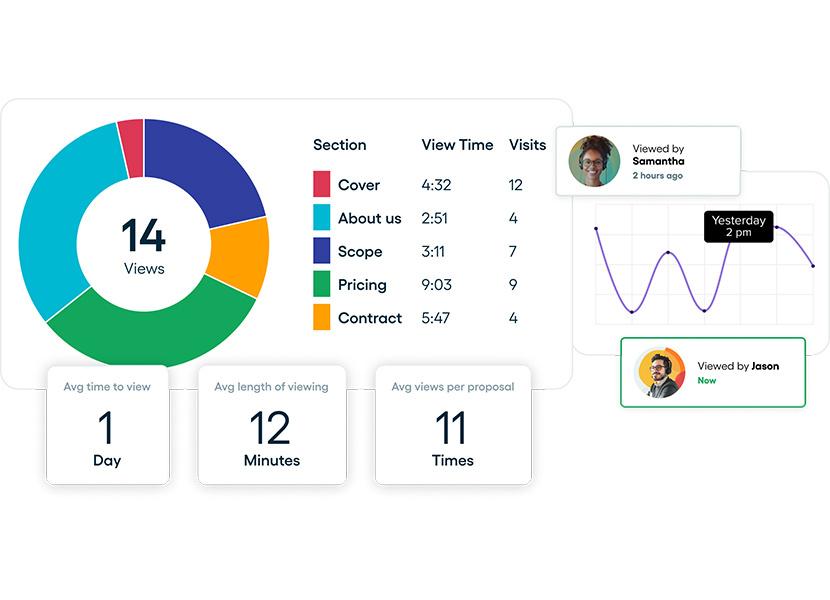
This has implications for how you think about follow-up. The question is not "did they read it?" The more useful questions are: which sections generated the most attention, which sections were skipped or skimmed, whether the document has moved beyond your primary contact to other stakeholders, and whether anyone has come back to specific sections after the initial read — which is almost always a sign that something there is generating either interest or confusion.
The answers to those questions tell you something genuinely actionable. If the pricing section is getting disproportionate attention across multiple sessions, that is where the internal conversation is happening. If the implementation timeline is being revisited, there is likely a concern there that has not been raised directly. If a new viewer from the same company domain has opened the document, your champion has shared it internally and the evaluation has expanded beyond your original contact.
None of this is speculative. It is behavior. And behavior is far more reliable than anything a buyer tells you directly, because behavior cannot be politely evasive.
The champion's invisible job
One of the things that gets lost in most conversations about B2B sales is the difficulty of the champion's role in complex deals.
Your champion is not just an internal advocate. They are a salesperson — selling your solution inside their organization, to stakeholders with different priorities, risk tolerances, and success criteria. They are doing this job without formal sales training, without the full context of your solution's capabilities, and while managing their existing responsibilities.
The proposals, decks, and documentation you send become their primary tools for this internal sale. And whether those tools are effective at answering the questions that actually arise internally — often questions that were never raised with you — largely determines the outcome of the deal.
Most salespeople think about the champion relationship in terms of alignment and coaching: making sure the champion understands the value proposition, helping them anticipate objections, giving them the language to make the internal case. This is all correct and important.
What gets less attention is the intelligence that flows in the other direction: what is happening in the internal process that your champion either cannot share or does not think to share, because they are in the middle of it and it is not yet clear what matters.
If a senior stakeholder has become skeptical about a specific aspect of the proposal, your champion may not surface that until it becomes a formal objection. By then, it is often too late to address it gracefully. But if you could see that a specific section of the document was being revisited repeatedly by multiple people, you could proactively reach out to your champion and ask if anyone had questions about that area — giving them the opening to surface something that might otherwise stay hidden until it derailed the deal.
This is not about pressure. It is about giving your champion better support at exactly the moment they need it.
Why the standard CRM does not solve this
There is a version of the response to the visibility gap that says: this is what CRM is for. You track stages, you set follow-up tasks, you log activities. The pipeline is visible. The problem is managed.
But CRM data is activity data — calls made, emails sent, meetings scheduled. It tells you what you have done. It tells you almost nothing about what is happening on the buying side between your activities.
The gap is not in tracking your own actions. The gap is in understanding what is happening inside the buyer's organization during the periods when you are not interacting with them — which, in most complex deals, is the majority of the deal lifecycle.
CRM was built around the seller's activity. It was not built around the buyer's process. The pipeline stage — "proposal sent," "in evaluation," "verbal commitment" — reflects what the seller believes is happening, based on the last conversation they had. It does not reflect what is actually happening in the buying organization right now.
This is why deals that look healthy in the CRM stall unexpectedly. The pipeline stage is a snapshot of a conversation, not a read on current buyer state. By the time the CRM reflects a problem, the problem has usually been developing for weeks.
The follow-up problem, more precisely stated
It is worth being specific about why generic follow-up fails, because the failure mode is not obvious.
The problem is not that following up is bad. Follow-up is necessary. The problem is that generic follow-up — "just checking in," "wanted to see if you had any questions," "following up on my previous email" — communicates something to the buyer that is almost never what you intend.
It communicates that you have no new information. That you are operating on your own internal clock rather than any understanding of their process. That your outreach is triggered by elapsed time rather than by anything relevant to their situation.
In a complex deal where your champion is managing multiple internal stakeholders and trying to build credibility for a decision, a salesperson who keeps showing up with nothing new to add becomes friction. Not hostile friction, but friction nonetheless. Another thing to manage. Another email to respond to with some version of "still in process, will be in touch."
The alternative — reaching out with something specific, something that demonstrates you understand where they are in the process, something that makes their job easier — lands entirely differently. It reinforces the champion's credibility. It provides something they can use. It arrives at a moment when it is actually welcome rather than burdensome.
The difference between these two kinds of outreach is not persuasion skill or relationship depth. It is information. The rep with relevant follow-up knows something the rep with generic follow-up does not.
Confidence without pressure
There is a principle that the best B2B salespeople understand intuitively but rarely articulate explicitly: you can follow up with full confidence and zero pressure if you know what you are following up on.
Pressure in follow-up comes from uncertainty. When you do not know what is happening, you reach out because you need to know — and that need leaks into the tone of your message in ways you cannot fully control. The buyer senses it. It makes them less likely to respond honestly, which increases your uncertainty, which increases the pressure in your next message. The cycle compounds.
When you know what is happening — when you can see that the document has been opened five times in the last three days, that a second person from the same organization has engaged with it, that the pricing section is getting repeated attention — your relationship with the silence changes completely. You are not reaching out because you are anxious. You are reaching out because you have a specific, relevant reason to. The tone is different. The content is different. The outcome is usually different too.
This is the version of sales intelligence that actually serves the buyer as well as the seller. It is not about catching anyone. It is not about surveillance. It is about being the kind of salesperson who shows up at the right moment with the right context — which is what every buyer says they want and what almost nobody consistently delivers, because almost nobody has the information that makes it possible.
The visibility gap is real, and it costs deals that should have closed. DocMetrics is a document intelligence platform that closes that gap — showing B2B sales teams exactly how their proposals are being read, shared, and evaluated, so they can follow up with confidence instead of guesswork. You can learn more at docmetrics.io.
DocMetrics Team
Writing about document sharing, analytics, and how teams use DocMetrics to track engagement and close deals faster.