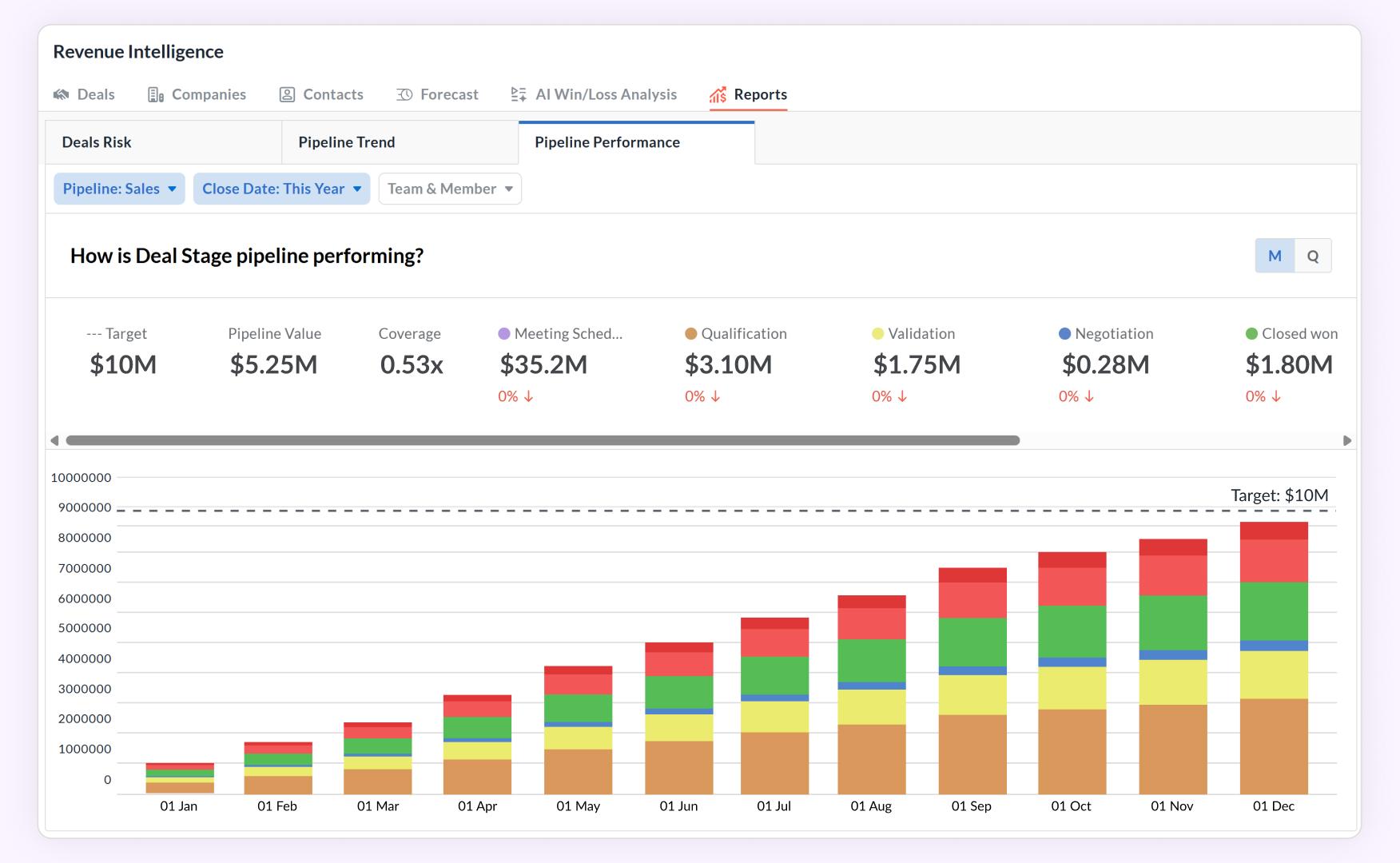
Every Monday morning, somewhere in a sales organization, a VP of Sales opens their CRM and looks at the forecast. There is a number at the bottom. It looks precise. It has a dollar sign in front of it and decimal points that suggest mathematical certainty.
It is, in most cases, fiction.
Not deliberate fiction. Nobody is lying on purpose. But the number is built from inputs that were never designed to produce truth in the first place. Stage progressions that reflect what a rep believes rather than what a buyer has done. Close dates that are really just "the end of the quarter, because that is when I need this to close." Probability percentages that nobody can explain the origin of, applied uniformly across deals that have almost nothing in common with each other.
This is not a pipeline problem. Pipeline problems are solvable with more activity, better qualification, sharper messaging. This is something underneath that — a revenue truth problem. The data the organization is using to make decisions does not reflect reality. It reflects hope, formatted to look like analysis.
Why the forecast is full of hope with a date attached to it
Think about what actually happens when a rep updates a CRM stage.
They had a good call. The prospect seemed engaged. They said something like "this looks promising, let me talk to my team." The rep, optimistic and under pressure to show pipeline movement, advances the deal to the next stage. They pick a close date — often the last day of the quarter, because that is the date that matters to their own number, not necessarily the date that reflects anything about the buyer's actual timeline.
Multiply this single act of optimism across every rep on a team, every week, across an entire pipeline, and you get a forecast that is structurally biased toward overconfidence. It is not that any individual rep is dishonest. It is that the system rewards optimistic data entry and provides almost no mechanism for the data to reflect what is actually happening on the buyer's side.
The result is a forecast that looks like analysis but functions more like a collection of best-case narratives, each one written by someone with a personal stake in the story being true.
This is the gap between activity data and outcome data. CRM stages are activity data — they record what the seller did and what the seller believes happened as a result. They are not outcome data, because they cannot independently verify what the buyer is actually doing, thinking, or deciding.
The stage that means everything and nothing
Consider the most common stage label in any CRM: "proposal sent."
This single stage gets applied to a staggering range of actual situations. A proposal that was sent and immediately forgotten by a buyer with no real interest. A proposal that triggered a frenzy of internal review across six stakeholders. A proposal that is sitting unopened in an inbox because the buyer got reassigned to a different project. A proposal that has been read four times, forwarded to two colleagues, and is currently the subject of an internal Slack thread the seller will never see.
All four of these situations get the identical label: "proposal sent." All four might get assigned similar close probabilities based on generic stage-weighting formulas. All four are, from a CRM's perspective, functionally the same deal.
They are not remotely the same deal. The forecast that treats them as equivalent is not measuring reality. It is measuring how many proposals went out the door, which is an activity metric wearing the costume of a prediction.
This is the core mechanism behind the revenue truth problem: the CRM measures what the seller did, not what the buyer is doing. And in any complex sale, what the buyer is doing after the proposal lands is where the deal is actually decided.
What buyer-side evidence actually looks like
If activity data is the wrong foundation, what is the right one? The answer is buyer-side behavioral evidence — observable actions taken by the people who are actually going to decide whether money changes hands.
This is a different category of information entirely. It does not ask the rep what they believe. It does not require anyone to self-report optimism or pessimism. It observes what happened.
Did the buyer open the proposal. How many times. Did they return to it after the first session, and if so, how many days later. Did anyone else from their organization open the same document. Did they spend disproportionate time on a specific section, and did they come back to that same section in a later session. Did engagement increase over multiple sessions or decrease. Did the document get forwarded internally, and is there any indication that the people it was forwarded to engaged with it meaningfully or just glanced and moved on.
None of this requires the buyer to say anything. It does not depend on a rep's read of a phone call, or their interpretation of a slightly enthusiastic email. It is behavior, captured directly, and behavior is far harder to dress up as something it is not.
This is the difference between asking someone how they feel about a product and watching what they actually do with it. The first produces narrative. The second produces evidence.
Why CRM data creates false confidence
The deeper issue is not that CRM stages are useless. It is that they create a specific kind of false confidence — the confidence of structure. A spreadsheet with stages, percentages, and dollar amounts looks rigorous. It looks like the output of an analytical process. The formatting borrows the visual language of certainty even when the underlying inputs are closer to vibes than measurement.
This matters because organizations make real decisions based on this false confidence. Hiring plans get built around forecasted revenue. Board conversations happen around pipeline coverage ratios. Individual reps get coached or put on improvement plans based on stage conversion rates that may have nothing to do with what is actually happening with their buyers.
The cost of the revenue truth problem is not abstract. It shows up as missed quarters that "came out of nowhere" — except they did not come out of nowhere. The buyer-side signals that would have predicted the miss were sitting in document analytics, email engagement data, and internal forwarding patterns that nobody was systematically looking at. The information existed. It just was not part of the forecast, because the forecast was built entirely from what sellers reported about their own beliefs.
A forecast built on hope with a date attached will always be wrong in the same direction — it will be too optimistic, because optimism is the input that gets rewarded at every stage of data entry. A forecast that incorporates what buyers are actually doing has a chance of being wrong in both directions, which is a meaningfully different and more honest kind of uncertainty.
The stall that looks like progress, and the progress that looks like a stall
One of the most damaging effects of relying purely on CRM stage data is that it cannot distinguish between two situations that require completely opposite responses.
The first situation: a deal that has been sitting in "proposal sent" for three weeks because the buyer is moving through a legitimate internal approval process that simply takes time. Nothing is wrong. The deal is progressing exactly as it should. Outside intervention from the rep would likely be unhelpful or even counterproductive.
The second situation: a deal that has been sitting in "proposal sent" for three weeks because the buyer opened it once, spent ninety seconds on it, and has not thought about it since. The deal is, for all practical purposes, dead. It just has not been formally marked as such because nobody has had the uncomfortable conversation yet.
From the CRM's perspective, these two deals are identical. Same stage. Same time-in-stage. Probably similar probability weightings. But one of them is healthy and one of them is not, and the difference is entirely invisible to a system that only tracks what the seller did.
Buyer-side behavioral data resolves this immediately. A deal where the document keeps getting reopened, where a second viewer from the same company has appeared, where time spent is increasing across sessions — that is a stalled-looking deal that is actually progressing. A deal where there has been a single ninety-second open and nothing since is a deal that looks identical in the CRM but is behaviorally telling a completely different story.
What this means for how forecasts should be built
None of this is an argument for abandoning CRM systems or rep-reported data entirely. Reps have context that no behavioral signal can capture — relationship history, organizational politics, competitive dynamics, budget cycles they have learned about through conversation rather than document engagement.
The argument is for a forecast that combines both layers rather than relying entirely on the layer that is most vulnerable to optimism bias. Rep-reported stage and probability should be one input. Buyer-side behavioral evidence should be a second, independent input. When the two align, confidence in the forecast should genuinely increase. When they diverge — when a rep has a deal marked at 80% probability but there has been zero engagement with the proposal in two weeks — that divergence is itself a signal worth investigating before the number goes into a board deck.
This is a more honest way to build a forecast, because it stops asking a single source — the rep, who has every incentive to be optimistic — to be the sole arbiter of truth. It introduces a second source that has no stake in the outcome and simply reports what happened.
The forecast will never be perfectly accurate. No forecast is. But there is a meaningful difference between a forecast that is wrong because the future is genuinely uncertain, and a forecast that is wrong because it was built entirely from hope wearing a spreadsheet's clothing.
DocMetrics exists because of this gap. It captures buyer-side behavioral evidence — document engagement, re-reads, internal forwarding, multi-stakeholder activity — and surfaces it as a second source of truth alongside whatever your CRM already tracks. It will not replace your rep's judgment. It will tell you when that judgment and the buyer's actual behavior are pointing in different directions, which is usually the moment that matters most. More at docmetrics.io.
DocMetrics Team
Writing about document sharing, analytics, and how teams use DocMetrics to track engagement and close deals faster.